
2026 Insight Report: Why Traditional Marketing Won’t Be Enough Anymore
And what the next generation of targeting means for commercial property.
Commercial property marketing is heading into one of its biggest shifts in years.
Not because the market is suddenly booming. Not because occupiers have radically changed overnight.
But because the information we now have access to is fundamentally different - and traditional marketing simply wasn’t built for it.
As we move into 2026, one thing is becoming clear:
Marketing that relies on broad messaging, generic audiences and surface-level data is no longer competitive.
Agents and asset managers who adapt to richer, real-time signals will pull ahead.
Those who don’t will keep spending more for less.
This report explores why that shift is happening - and what it means for how you attract and convert occupiers in 2026.
The data landscape has changed - but most marketing hasn’t
For the past decade, commercial property marketing has looked roughly the same:
Localised campaigns
Broad professional targeting
A generic CTA (“Download the brochure”)
Activity-led decisions rather than insight-led ones
Meanwhile, the data world has evolved dramatically.
Today, it’s possible to understand a company far beyond industry and postcode.
We can now access:
Firmographics that update weekly
Leadership changes that signal expansion or consolidation
Funding rounds, acquisitions and hiring surges
Geo-mobility patterns linked to commuting and office behaviour
Psychographic indicators like DiSC patterns for decision-makers
Lease events and property-related behaviour inferred through multiple sources
This isn’t “nice to have” data anymore.
It’s the new baseline for understanding who is genuinely in-market.
Traditional marketing still treats all companies as equal. 2026 marketing won’t.
Audience targeting is becoming a precision game
The days of “target business owners within X miles of the scheme” are over.
The highest-performing marketing in 2026 will be:
Hyper-selective - only targeting companies showing real indicators of change
Hyper-relevant - with messaging shaped by what those companies are actually doing
Hyper-timed - deployed when signals show they’re most likely to be making a decision
This creates a seismic shift:
Instead of pushing a scheme out to the market…
Marketing becomes a mechanism for finding the right occupiers at exactly the right moment.
Traditional methods don’t have the tools to do that. They weren’t built on live data, behavioural signals or psychographic understanding.
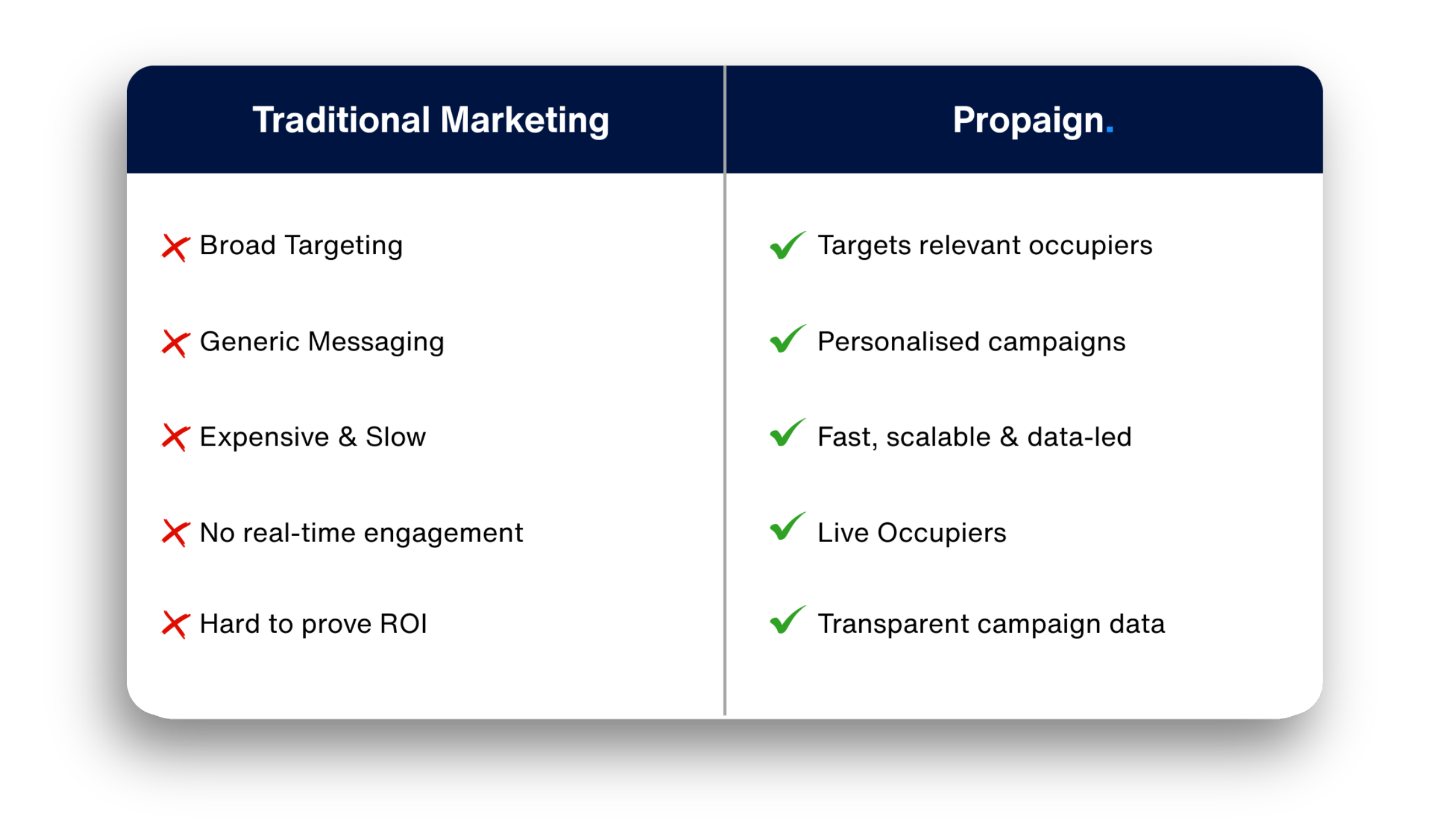
Messaging must now match the individual - not the market
2026 will reward one thing above all else: personalisation that feels intelligent, not automated.
With richer insight now available, we can tailor messaging far more deeply:
What industry someone is in
How they are growing
What challenges they are signalling
Their decision-making profile
Their geographic movement patterns
Their role in the leasing journey
This goes far beyond adding a first name to an email.
Traditional CRE marketing relies on a single campaign message:
“Flexible space available. Great location. Download the brochure.”
That message doesn’t adapt when the occupier’s context changes.
In 2026, it will need to.
The market is fragmented and generic campaigns can’t keep up
The commercial real estate market is no longer moving as one.
Some sectors are expanding
Some are consolidating
Some are relocating to lower-cost regions
Tenant behaviour varies drastically across submarkets
Traditional marketing assumes a single narrative for the whole market.
But now, a scheme can have 15 different occupier profiles, each with different motivations, risks and timelines.
Marketing that speaks to “everyone” ends up speaking to no one.
2026 will require marketing that is:
Scheme-specific
Occupier-specific
Signal-specific
This is where intelligent outreach becomes a strategic necessity, not an optional upgrade.
2026 will belong to agents who use marketing as a discovery engine
This doesn’t replace leasing expertise. It amplifies it.
The next generation of marketing tools won’t just promote space. They will:
Reveal occupiers agents don’t yet know about
Highlight who is actively engaging and who isn’t
Provide behavioural insight to prioritise follow-up
Reduce reliance on outdated assumptions or legacy databases
Give agents a clearer picture of what the market is really doing
In other words:
2026 marketing becomes less about broadcasting, and more about uncovering.
Traditional campaigns don’t have the depth of insight to surface this and agents are left guessing who is genuinely considering a move.
Data-driven platforms now remove that guesswork.
What this means for agents and asset managers
You don’t need to become a data scientist.
You don’t need to learn new software stacks every quarter.
But you will need a marketing approach that:
Uses richer audience insight than your competitors
Targets beyond your CRM and internal databases
Surfaces occupiers you would never discover through traditional methods
Aligns your campaigns with actual market behaviour
Delivers engagement signals directly into your hands
Helps you act faster - with more confidence and better timing
Traditional marketing cannot deliver this level of intelligence. 2026 demands it.
The opportunity ahead
We’re entering a phase where marketing becomes one of the most powerful tools in the leasing process - not because it replaces agency work, but because it enhances it.
The agents and owners who will win in 2026 are those who embrace the shift early:
From broad targeting → to precision audiences
From generic messaging → to signal-led personalisation
From passive promotion → to active discovery
From guessing → to knowing
This is the future the industry is moving toward. And for once, marketing isn’t playing catch-up - it’s leading the way.
Propaign was built with this 2026 landscape in mind: richer insight, smarter targeting, meaningful engagement and clear visibility for agents.
Not as a replacement for leasing teams but as the modern marketing engine that empowers them.
The industry is changing fast.
The marketing supporting it need to change too.
