
The Great Market Fragmentation: Why 'Grade A' is a Ghost Signal
Recent commercial property reports point to a clear direction: markets aren’t just tightening, they’re fragmenting.
Markets are splintering, and "Grade A" is no longer about prestige - it’s a relevance signal. Demand is concentrating around assets that actually solve for the modern workday. It’s not "new for the sake of new"; it’s a flight to utility. The winners are buildings that lean into hybrid realities, lead with experience-driven amenities, and aggressively strip friction from the daily grind.
“Grade A” isn’t a finish, it’s a response to occupier behaviour
The shift we’re seeing isn’t simply a preference for better specs. It’s a preference for buildings that help occupiers solve three very current problems:
How do we make the office worth the commute?
How do we protect the experience and productivity of the days people do come in?
How do we reduce risk (in cost, compliance, and future flexibility) over the next lease term?
When those questions sit behind decision-making, the definition of “best space” becomes much more specific, and the stats reflect that concentration.
What occupiers are prioritising, in plain terms
Across recent surveys and market commentary, the “relevance stack” is becoming clearer. It’s not one feature - it’s a cluster of non-negotiables and deal shapers.
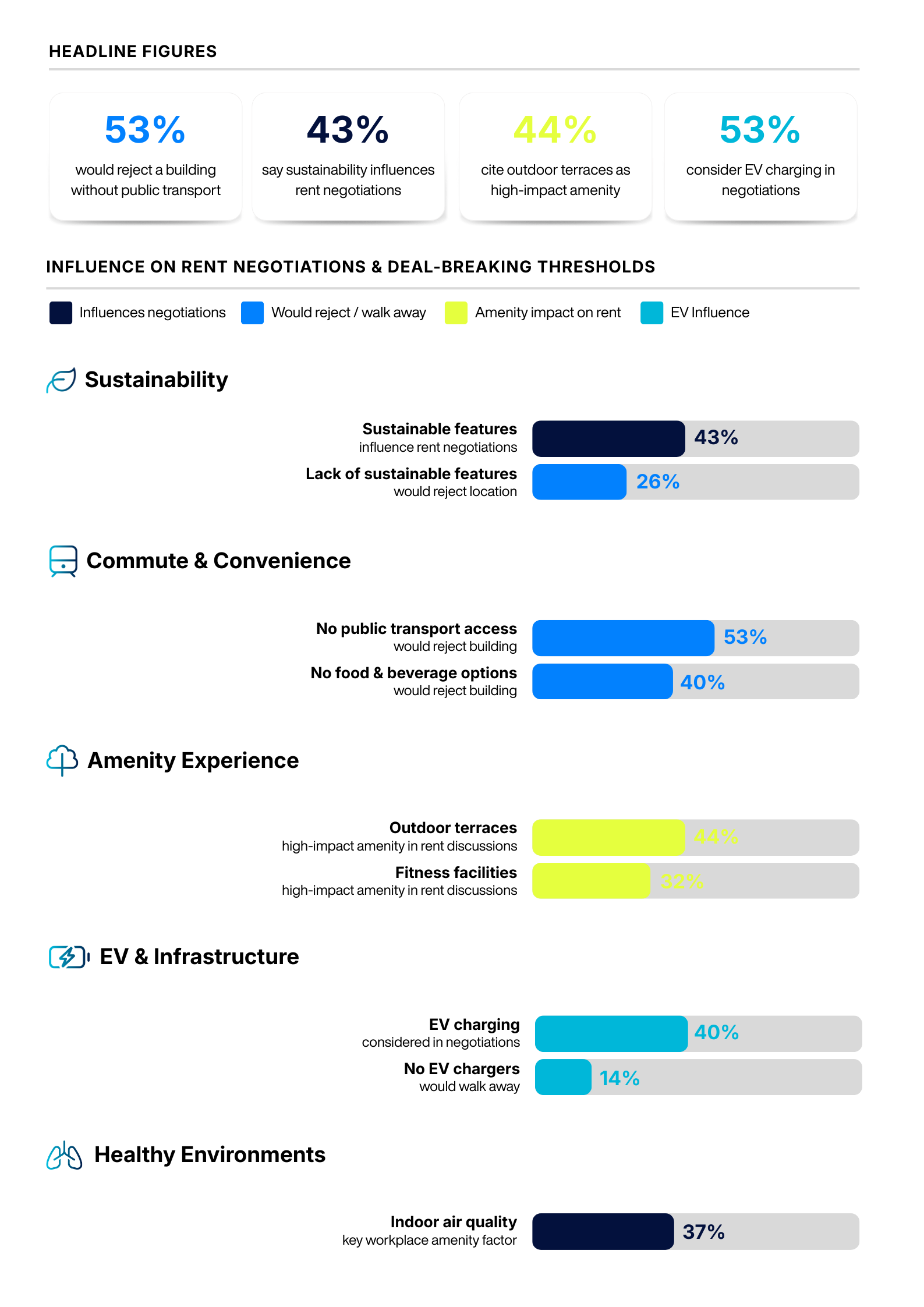
Why the market is polarising
Once you see “Grade A” as a shorthand for relevance, the market polarisation makes sense. Demand concentrates in the assets that remove friction and support modern operating models - while secondary assets need much clearer value propositions (price, flexibility, repositioning, or a very specific niche demand).
We can see that polarisation in take-up - in London, Grade A accounted for 69% of quarterly leasing in early 2025.
At the same time, the best new-build stock is increasingly scarce. JLL notes new-build vacancy tightened to around 1.2%, indicating pressure on the top end of supply.
Put simply, the market isn’t “down” in a uniform way, it’s selective. And it’s becoming more selective as occupiers optimise portfolios around attendance patterns, cost scrutiny, ESG expectations, and talent needs.
What this means in practice: The shift from "Broadcasting" to "Precision"
If demand is more specific, a "one size fits all" leasing campaign is a wasted budget. Success now depends on shifting from a generalist approach to a high-resolution strategy in three areas:
1. Positioning: Sell the Outcome, Not the Asset
Occupiers aren't looking for square footage; they are looking for a "Return on Commute."
The Old Way: Marketing "High-spec HVAC and BREEAM Excellent."
The New Way: Marketing "A productivity-first environment that reduces sick days and meets Corporate ESG mandates for 2030."
Action: Audit your marketing collateral. If it reads like a list of technical specs rather than a solution to a business problem (talent retention, carbon reporting, hybrid friction), it won't resonate with the C-suite.
2. Targeting: Decode the Fragmented Market
Because the market is polarising, the "ideal tenant" profile has fractured. The same 10,000 sq. ft. floorplate could be a consolidation play for a declining firm or a prestige play for a scaling tech boutique.
Action: Stop chasing "the market" and start chasing "the signal." Use data to identify which companies have lease events approaching, which are hiring in your specific micro-location, and which have made public commitments to the specific amenities your building offers.
3. Proof: Default to Transparency
In a tight market with 1.2% new-build vacancy, "Grade A" is a claim that requires immediate receipts. Occupiers are increasingly risk-averse.
Action: Front-load your evidence. Have the digital twin, the energy performance data, and the commute-time maps ready from first contact. If you can’t prove the "relevance" of the space through data, you lose the defensibility required for them to sign a long-term lease.
The takeaway
Demand hasn’t disappeared; it has specialised.
The winners in this fragmented market won’t be those who shout the loudest or spend the most on broad-reach advertising. They will be the ones who decode real-world occupier movement, spot intent before it hits the open market, and match the right space to the right requirement with surgical confidence.
That is the exact principle Propaign applies every day. We turn fragmented occupier signals into earlier, clearer targeting and more relevant outreach - ensuring your asset isn't just seen, but is recognised as the relevant solution.
