
AI firms are accelerating UK office demand, but the real story is industry alignment
The role of AI in the UK office market is beginning to shift. For a long time, artificial intelligence was largely discussed as a technology trend that would change how businesses operate, automate processes, and reshape productivity. Increasingly, it is also becoming an occupier story.
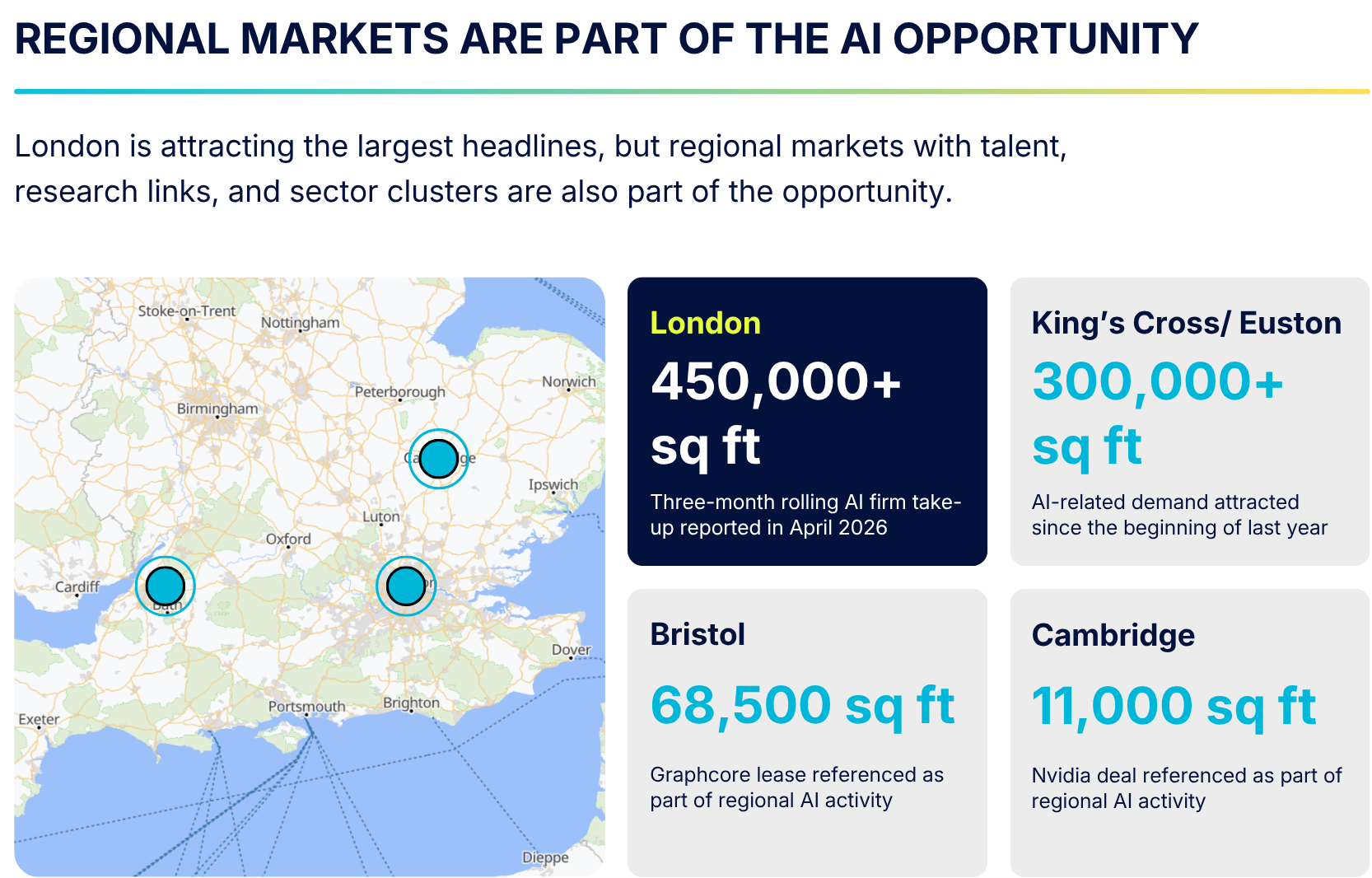
Recent analysis reported that companies which are developing artificial intelligence technologies have reached record leasing levels, with activity accelerating across UK office markets in the first four months of 2026. In London, three-month rolling take-up from AI firms reached more than 450,000 sq ft in April 2026, almost double the level recorded in March and significantly above the 2025 average of around 40,000 sq ft.

The significance is not simply that AI companies are taking more space. It is what this tells us about how demand is being identified, understood, and acted on across the office market.
AI is becoming a leasing signal, not just a sector label
The increased focus on AI occupiers reflects a wider change in how landlords, asset managers and agents are thinking about demand. Rather than looking only at traditional indicators such as lease events, headcount growth, or location, more property teams are now thinking about industry alignment as a core part of their leasing strategy.
For AI firms, that alignment is often shaped by a combination of factors:
Access to specialist talent
Proximity to universities, research institutions and innovation ecosystems
Connection to established technology clusters
Ability to attract and retain highly skilled teams
Space that supports collaboration, experimentation and growth
A location that strengthens credibility within the wider sector
This is why locations such as King’s Cross, Euston, Cambridge and Bristol are becoming increasingly relevant in the discussion. CoStar noted that the area around King’s Cross and Euston has attracted more than 300,000 sq ft of demand from AI firms since the beginning of last year, accounting for almost half of AI-related deals. The same article also highlighted regional activity, including Graphcore’s 68,500 sq ft lease in Bristol and Nvidia’s 11,000 sq ft deal in Cambridge.
These movements point to a market where sector relevance, ecosystem strength and location strategy are becoming more closely connected.
The office still matters to high-growth technology firms
The acceleration of AI leasing also challenges the idea that technology businesses are moving away from physical office space. In reality, many AI firms are highly dependent on the things that good office locations can provide, including talent density, collaboration, investor confidence, client proximity and access to wider innovation networks.
For fast-growing businesses, the office is not simply a place to house employees. It can become part of the company’s growth infrastructure, particularly for businesses operating in highly competitive, knowledge-intensive sectors.
When a company is scaling quickly, developing complex products, recruiting specialist teams and competing for visibility, the physical environment still plays an important role.
The right office can support:
Faster collaboration between technical and commercial teams
Stronger employer brand
Better access to academic and research networks
Greater visibility within an established industry cluster
Confidence for investors, partners and clients
This does not mean every AI firm will require large amounts of space, nor does it suggest that AI demand will behave in a uniform way. It does reinforce that for certain companies, particularly those moving from early-stage growth into scale-up or enterprise delivery, the office can remain strategically important.
Why industry alignment is becoming more important
Occupiers are no longer choosing space based on specification alone. They are looking for locations and buildings that align with how their business operates, where their teams are based, and what their next stage of growth requires.
For landlords and agents, identifying an occupier within a certain industry like AI is not just about finding a company with “AI” in its description. It is about understanding whether that company has a genuine reason to consider a particular location or building.
That might include:
A nearby university or research institution
Existing AI, technology or data occupiers in the same area
A regional skills base that supports future hiring
Recent funding or expansion activity
A business model that requires collaboration-heavy workspace
A move from flexible or temporary space into a more established office
A current lease event or operational trigger
The strength of the opportunity comes from the combination of these signals, rather than any single factor in isolation. An AI company with recent funding, growing headcount, a location connection and a need to access specialist talent is a very different prospect from a company that simply uses AI as part of its product messaging.
This is not just a London story
London’s AI leasing activity is naturally attracting attention, particularly because of the scale of recent deals involving major global AI and technology firms. The wider opportunity is not limited to the capital.
Regional markets with strong talent pipelines, university ecosystems, sector specialisms and credible innovation clusters are also well placed to benefit from AI-related demand. Bristol and Cambridge are already being referenced in recent leasing activity, but the principle applies more widely.
For regional office markets, this creates an important opportunity. Rather than relying only on broad occupational demand, schemes can be positioned around the specific sectors that already have a reason to be there.
For AI and adjacent industries, this might include:
Data science
Cybersecurity
Advanced engineering
Defence technology
Robotics
Life sciences
Fintech
Research-led professional services
The opportunity is not always about attracting the biggest names in AI. In many markets, the more realistic and valuable opportunity may be identifying smaller and mid-sized firms that are growing, hiring, raising capital, or looking for a location that better supports their next stage.
The risk of chasing the trend too broadly
As AI becomes more visible in the office market, there is also a risk that it becomes over-simplified. Not every AI firm is expanding, not every AI firm needs office space, and not every office building will be relevant to an AI occupier.
The market needs a more disciplined approach than simply adding AI companies to a target list. The better question is not which AI firms exist. It is which AI firms have a credible reason to consider a specific building, in a specific location, at a specific point in time.
That distinction matters because, as demand becomes more selective, relevance becomes more important than volume. A smaller group of well-aligned occupiers will often be more valuable than a broad list of companies with only a loose sector connection.
What this tells us about the future of office demand
The acceleration of AI leasing is not just a story about one fast-growing sector. It is a sign of how office demand is evolving.
Occupier targeting is becoming more evidence-led. Location strategy is becoming more closely tied to industry ecosystems. Sector alignment is becoming a stronger part of how schemes are positioned.
For property owners and agents, this means the most valuable demand may not always be visible through traditional market activity alone. It may sit within companies showing earlier indicators of change, including:
Growth
Funding
Hiring activity
Expansion plans
Sector momentum
Location relevance
AI is one of the clearest examples of this shift. The office market is not moving back to a broad, one-size-fits-all model of demand. It is moving towards a more selective environment, where the strongest opportunities are shaped by fit, timing and relevance.
As AI firms continue to scale across the UK, the schemes that understand that alignment early will be better placed to capture demand before it becomes obvious to the wider market.
